Saturday, July 14, 2012

What is Typical?


July 14, 2012,
What is typical?
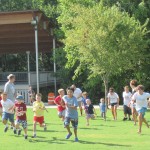
Many times, when a parent finds out their child has a diagnosis of Autism or any other social delay, the disappointment that we hear most frequently is: “I won’t ever get to play ball with my son or see him play on a “typical” sports team”. The way we structure our groups at Learning on the Log, many times you are unable to tell if the group is “typical” or “special needs”. We start each day with warm-ups, stretches, team cheers, and then sports. When looking at the group as a whole, the only difference you might notice is the abundance of staff that are playing alongside the kids, otherwise it is truly difficult to tell the difference. What does a “typical” child get out of playing sports and being on a team? They learn to be part of a group, they learn to take turns, they learn to cheer for their friends when they are successful and to mourn their losses, they feel success when they perform well, they learn strategy and thinking in the moment. Our kids learn all of these things and start to care about them; they just need some extra support to get there. The advantage these have over other children is they start to understand and feel empathy for others, when they see them having a hard time. Because tour kids start to recognize they are different and need some help along the way, with the right social support, LOTL children start to care about and empathize with the “little guy” and they then want to help out. In the long run, the skills our children are learning are just as important, if not more important than what a typical child learns on a sports team. Maybe we should redefine what is typical and what qualities are important for our youth…..


Friday, July 13, 2012

Hands in the Middle


IMG_8342

This is a daily, if not multiple times a day, tradition we embrace in all our Learning on the Log programs. Just like sports teams, Learning on the Log attempts to gain a "team" feeling within all of our groups. This exercise requires everyone (kids and adults) to put their hand in the middle of the circle and on the count of 3, they cheer for a common goal (usually the next transition or activity). It is challenging for many reasons. You have to be in very close proximity with other people and for many of our campers, they initially find this incredibly uncomfortable and if not supported by a staff, they would just walk away or refuse to participate. You have to sustain focus on a common goal for longer than some of our campers find comfortable. You have to sequence the directions, hear the word to use, listen to the countdown, and then lift your hand in sync with the group, as well as say the cheer at the right time. All of these steps are difficult for many of our campers to track. But, because we do this on a very consistent basis, the kids start looking forward to joining in, they slowly become less and less uncomfortable with different aspects of it and soon are enduring closeness like never before. They are able to focus for longer and longer without help, and they are all incredibly proud when the sequencing goes right and they all cheer at the same time. This is an incredibly important practice, because: it introduces consistency, it encourages team work, the campers feel like they can be successful in uncomfortable situations, everyone cheers together for a common goal, and overall the kids leave the group energized, organized, and excited for the upcoming activity.

Thursday, July 12, 2012

The Importance of Downtime

IMG_8006

July 12, 2012
The Importance of Downtime
We get asked this question multiple times, why do you drive around so much in your programs? Isn't that a waste of the day? We don't think so, and this picture is a prime example of why.....our campers work hard while they are at camp. They get sweaty, tired, grumpy, their engines get high due to the tough social interactions, and we tend to go-go-go. The transition time in the vans gives everyone a chance to calm their bodies and emotions down. They re-charge by reading, playing with small toys, singing to the kid's CD's, talking with their neighbor (kids and staff), or even taking a nap. This ensures their little bodies are ready to go for the next activity, and we find that they are much more open to being challenged and trying new things after they have had time to re-charge in the vans.

Wednesday, July 11, 2012

Water guns and Social etiquette


IMG_8048
July 11, 2012
We have so enjoyed our water guns, that have mostly been donated by parents. Even during “adult swim” where the kids have to sit out for a few minutes, the water guns are a great tool for engaging and interacting in play. For children who find it hard to ask a friend to play with them or try to get a counselor’s attention, these water guns give them an easy avenue to try. Our staff are then able to use this as a tool for appropriate play. We talk to the child about how they need to ask someone first, “do you want me to squirt you” or “can we play together”, before shooting them. Or, if they do squirt someone and they get mad, we are able to support them in that interaction of explaining why they squirted them, and help them to see the more appropriate “water gun etiquette” in their next interaction. If someone says no, than we are also able to support the camper in this feeling of disappointment. This is a prime example of how our campers learn appropriate social interaction techniques, organically, in everyday situations that they can then use in future interactions with friends and family.

Job Well Done


IMG_3842
July 10, 2012
This camper is so excited to have his face painted and is incredibly proud to have received his medal. These are handed out as a “job well done” to our campers for all of their hard work. All of the children experience a lot of fun each week, but they also have to work through many tough “social situations”, which should definitely be rewarded! They work on conflict resolution, how to be a good team member, how to respond to disappointment, and how to communicate tough feelings such as anger or jealousy.
Job well done to all of our campers each week!

Thursday, May 31, 2012

What to expect at Summer Camp

The Learning on the Log newsletter: "the LOTL Letter", edition 1
Read all about our first week of camp and how you can help us, as we provide the social support necessary for children to succeed!

Pictures from our first two days of camp......


Thursday, May 24, 2012

Why we are different

What sets us apart from other similar programs? Here is a little description of:


Why we are different

Learning on the Log provides recreational programs such as hiking, swimming, gymnastics, team sports, team building games, and boating....in natural settings that help foster development and social/relationship skills.  Unlike other social skills programs where the children meet in a therapists office, our children develop social skills, in natural situations such as hiking together on a trail, playing games in a pool, navigating a playground, or testing their skills on a sports field. 

Through the development of friendships with our staff and other children, each child encounters scenarios that will have a greater meaning to them personally, therefore motivating them to try again.  Lessons learned during meaningful interactions, have a greater chance of generalizing to other social situations, such as with their parents, siblings, and with teachers and peers at school. 

We believe that social skills and strategies are learned through spontaneous and organic situations. Our staff work very hard to nurture and support any conflicts that arise naturally when you put a group of kids together. Such as: misunderstandings, winning, losing, or dealing with challenging feelings.  Our activities are temporarily stopped or the children involved are taken aside, when a conflict arises, in order to process these social breakdowns. 


We support them in understanding what actually happened versus what they perceived to happen, and we help them work through how they feel about that and resolve the conflict. The activity is then continued, or the child re-joins after having talked through the incident.  This emphasis of processing, charged social-emotional episodes, sets Learning on the Log apart from other recreational programs who only emphasizes a sensory experience.  Any social growth there is incidental.


Throughout the year we offer: 
Coming soon:
You can remain updated of all that is going on by following us: 
How can you help? 
Thank you for visiting our blog, we hope to hear from you soon! 

Katie and Armann